
High-performance racing: Innovation transfer
Competition has been the engine of foiling innovation, producing advanced foils, control systems, and structural solutions. The debate lies in transferability: what can mainstream builders realistically adopt, and what is locked behind extreme rules and budgets? Some view racing as a test bed; others caution it creates expectations that don’t match market realities.
Speakers
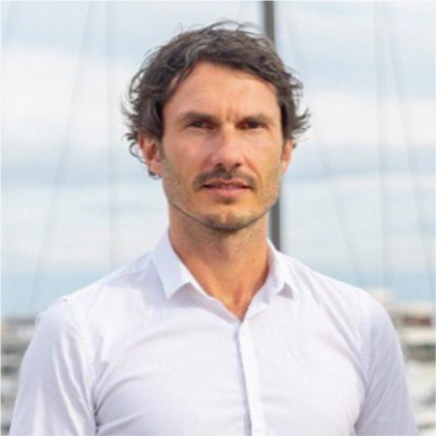
Francis Hueber is a Naval Architect and Co-founder of Caponnetto Hueber SL, with over 20 years of experience in high-performance, foiling, and efficient yacht design, as well as CFD, aerodynamics, and hydrodynamics.
A graduate of ENSTA Bretagne, he has played a key role in six America’s Cup campaigns, winning in 2010 and 2013 with BMW Oracle and ORACLE TEAM USA, and securing the Prada Cup in 2021 with Luna Rossa.
At Caponnetto Hueber, Francis leads the strategic direction, overseeing business development, client relations, and R&D project initiatives, while guiding the technical execution. He facilitates and stimulates the team’s creativity, helping them imagine and develop new ideas for the future of yachting and maritime transportation.

Jean-François Cuzon is the founder and CEO of Pixel sur Mer, a leading company providing advanced technological solutions for competitive sailing, yachting, shipping, defense, and aeronautics. With more than 25 years of experience in ocean racing and a world championship title in the 470 class (1999), he has long combined high-level athletic performance with engineering expertise. He also brings over 20 years of experience in engineering, embedded electronics, and complex onboard systems.
He graduated from INSA in 2001 after completing a dual curriculum in elite sports and engineering. After his studies, he joined Michel Desjoyeaux’s Mer Agitée team, contributing to major offshore racing projects. He later became part of the Areva Challenge team in Valencia for the 32nd America’s Cup, working as a systems and navigation engineer during the early Louis Vuitton Cup regattas.
In 2008, he founded Pixel sur Mer with the ambition of bringing innovative, data-driven technologies to professional sailing and beyond. Today, Jean-François also sails aboard the Wally V, continuing to blend technical excellence with his passion for navigation.
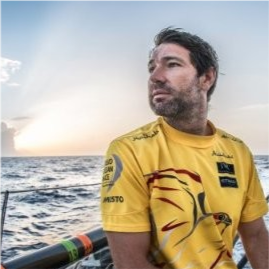


Fabrizio Marabini is an aerospace engineer with more than thirty years of experience in performance technology and high-level sailing projects. After graduating from Politecnico di Milano, he began his career in aeronautics and later joined several America’s Cup teams, including Il Moro di Venezia, Prada Challenge, Mascalzone Latino, Artemis Racing, Emirates Team New Zealand, and Luna Rossa Challenge. Over the years, his work has focused on performance analysis, load monitoring, software development and onboard electronics, following the evolution of sailing from conventional yachts to modern foiling boats.
In 2011 he co-founded FaRo Advanced Systems, a company specialized in instrumentation and control systems for racing sailboats. With the growing relevance of foiling, FaRo has extended its work to both sailing and motor applications, developing integrated mechatronic systems spanning from sensors engineering to data acquisition, from PLC programming to automatic control.
Fabrizio’s experience lies at the intersection of engineering and competition, where innovation is driven by practical needs and constant testing. His perspective connects the technological advances achieved in top-level racing with their potential use in broader marine contexts — exploring not only what can be transferred from racing to production, but also what remains specific to the competitive environment.