
Design that has stood the test of time
One DAME Design Awards winner is still in production 34 years later with only minor changes, a testament to its concept and highly successful execution.
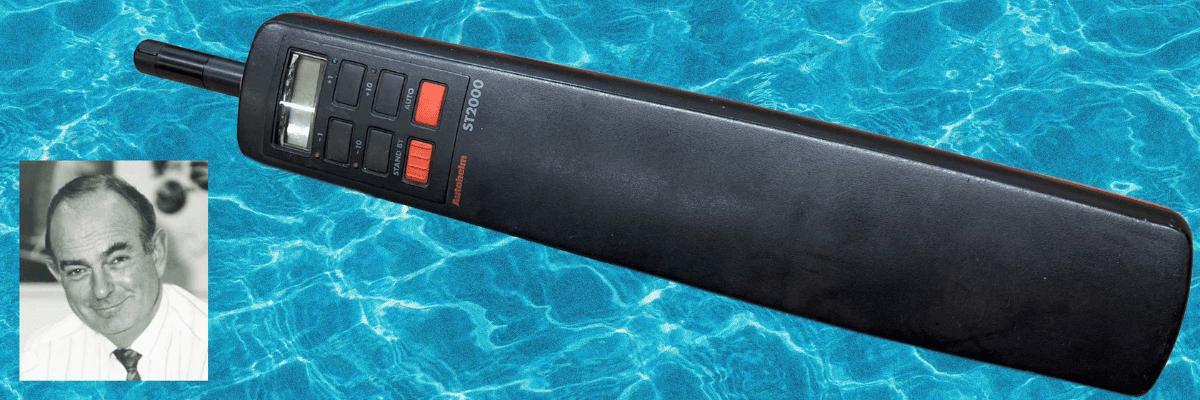
The 1992 DAME Design Awards winner is a brilliant example of what happens when the genius and vision of a marine industry pioneer inspire the skills and determination of a young team in a rich vein of form. It was more than half a century ago that aeronautically trained engineer and keen sailor Derek Fawcett tried to pitch the idea to his then employer of a self-contained electronic autopilot with an electrically actuated ram that would simply attach and detach onto the cockpit coamings and tillers of mainstream yachts to provide an uncomplicated self-steering capability. Fawcett was told there would not be a market for his concept. Undeterred, he left to found Nautech in the UK and developed the first Autohelm product in his garage.
Once in production Autohelm AH-series tiller pilots soon found a ready market which established Nautech’s foundations in the mid 1970s. They were fully standalone and revolutionary for their time, a much more accessible way of steering a yacht for mainstream users compared to the often-complex mechanical windvane systems that had gone before. In its basic set up you clipped the AH to the tiller, plugged in its 12VDC supply, set its integrated magnetic compass to the desired relative heading, nudged a dial for sea state to ‘calm’ or ‘rough’ and then let the autopilot do the steering. An optional wind vane transducer was available, enabling the pilot to respond to wind direction.
Fast forward to 1989 when Nautech introduced another disruptive range of products – the SeaTalk instrument and networking system. This provided far richer communication between electronics than the then six-year-old industry standard NMEA 0183 protocol, and provided instrument power as well, all on the same easily connected single cable.
Peter Dudman joined as the company’s General Sales Manager in 1990 at around the time Nautech was acquired by Raytheon and remembers those heady days:
"The emergence of SeaTalk marine instruments soon sky-rocketed growth to significant double digits and led to opening a new factory. It was an interesting time in the development of Autohelm products, which everyone believed would be a success.”
Next generation tiller pilots
That sets the scene for the subject of this article, the launch and DAME success of the largest of two new Autohelm tiller pilots in 1992. Dudman continues:
“The ST2000 was the second generation of the company’s tiller pilots – replacing its original AH2000 model. The major breakthroughs were the incorporation of a fluxgate compass in the back end of the unit and the addition of networking over Autohelm’s SeaTalk network. There was also an ST1000 model for smaller yachts.”
These new models provided the opportunity to exploit latest technologies and refine the mechanical and electronics design using nearly two decade’s worth of experience. Careful attention was also paid to aesthetics, as the company’s then model maker and industrial designer, Richard Lovelock, explains:
“At that time Derek Fawcett teamed up with a well-known industrial designer and artist called John Wickham. John did the styling work for the ST50 instrument range. I joined Autohelm at this time and then worked closely with him on the ST2000. It was his design and I was the model maker. This was before the advent of CAD, so I modelled the early designs by working from drawings just for visual purposes. I also made prototype casings for the engineers to fit the electronics into.
“The ST2000 had quite an organic shape. When the tool makers came to interpret the complex curves of the design they could not do it. So, they carved the rough form out of a lump of carbon and then I was given the job of sculpting it to ensure the radii were correct. That model was used to create the tooling for the ST2000’s injection mouldings.”
Richard would go on to create the designs for several other new Autohelm products. Often the company’s catalogues would feature pictures of his models as the photography was scheduled as much as six months before launch. His models featured on boat show stands around the world when their dates meant not being able to show actual product yet. He was also later engaged to create the aesthetic design for the TackTick range of instruments, which took an overall DAME Awards win 11 years later.
An energetic and creative environment
Looking back to those years, Richard remembers the energy and creativity of the Autohelm team:
“It was a pre-computer age. We’d go in and sit with Derek Fawcett and a few other colleagues. Derek would say “we’re thinking about doing this” and he'd sketch the idea out. I’d go away, make it and come up with a few ideas of my own and John would put the finishing touches to it."
“Our Sales Director, Ian Godfrey, sailed with British Prime Minister Ted Heath and had his finger on the pulse of what the sailing community needed. It was a fantastic place to work with a very young group of people. Everyone was there all hours just because they enjoyed it.
“Derek was a brilliant engineer. He was apprenticed at de Havilland so he was an aeronautical designer, but he also had an instinctive feel for marketing, and he loved good design and styling. He knew exactly what to do with the packaging and how to present the product. He was the fully rounded businessman, smart but a lovely person too.”
DAME Design Awards 1992 winner
All that attention to detail obviously paid off and the ST2000 was named overall winner of the DAME Design Awards in 1992. The official commendation read:
“The design of this product appealed to the jury, being the first tiller autopilot to integrate a complete navigational system. Furthermore, the design of the casing meets the demand for a robust electronic product used in an exposed location and provides an excellent housing for the actuator assembly and fluxgate compass. The incorporation of the keypad into the casing with a built in LCD and six button display was a further functional feature which impressed the judges for its ease of use and originality.”
Ironically, after all that effort, Derek Fawcett and Ian Godfrey weren’t present to hear the winning announcement, as Peter Dudman recalls:
“The person who picked up the award that year was our PR manager Liz Botting. The directors had decided we didn’t have a chance of winning and left Liz and I there!”
Little change over 34 years of production
The passage of time has proven how well the 1992 DAME Jury selected their top winner. SeaTalk tiller pilots have been in continual production for more than three decades, surviving the company’s evolution from Raytheon ownership to management buyout Raymarine and then via recession hit times into new growth via acquisition by FLIR and ultimately, Teledyne.
Visually there are a few obvious changes with the ST2000’s casing – the colour has switched from black to grey and the keypad detail is modernised to match more the more recent Raymarine look. But fundamentally the ST2000+, as it is now termed, remains close to the original design. Search the internet to find other examples of electronic equipment that has remained in production for 34 years and you’ll see this is an astonishing achievement for any product, marine or otherwise.
“One of the remarkable things about the ST2000+ is just how little development it has had from its original launch" confirms
Raymarine’s current Product Development Director, Jamie Cox.
“I have been the company since 2011 and the ST2000+has required virtually no development in that time, a testament to the original concept. Today it remains the market leader with only one true competing product. Given the changes of company ownership over the years, it’s hard to provide accurate numbers but I would estimate that more than 100,000 ST2000 and ST2000+ autopilots have been manufactured since this model won the DAME Design Awards.”
Raymarine also currently holds another DAME Design Awards record, being the first (and so far, only) company to reach three overall wins. The Autohelm ST80 instrument series claimed the top prize in 1996 and its RL80C and RL80CRC Colour Pathfinder Radar Plotters were crowned in the Millennium edition of the DAME four years later. These products each represented significant steps within the marine electronics sector, but their lifespans were much shorter.
Derek Fawcett is sadly no longer around to see his award-winning design continue in production, having passed away in 2023. When he retired from Raytheon, Derek applied his talents to many charitable causes, including inventing an audio compass system for visually impaired sailors and founding an organisation to enable sailing for the disabled that grew into the UK’s national sailing body’s RYA Sailability programme. He was also materially involved, for no reward, in encouraging a team of young engineers to successfully launch the Skyforce range of instrumentation for the leisure aviation market.
Wheel steering has become a norm for a larger proportion of new build smaller yachts than would have been the case in the 1990s. But given a huge legacy fleet and a trend to return to simpler things in life the tiller pilot still has a very important part to play in global armoury of marine equipment. Particularly as these units remain very accessibly priced. If judged for demonstrating how great design can return investment year after year, the ST2000+ and its smaller ST1000+ sibling surely stand as true classics of our time. A case study to prove ‘if something is designed well, leave it alone.’
What are your memories of the DAME Design Awards over the years?
For this special 35th anniversary year we are publishing a series of features looking at the winners – who they were, why they won and what they meant within the leisure marine sector.
We would very much like to hear the memories of anyone involved with nominated and winning entries since 1991, particularly the overall winners. If you can help us, then please email dame@rai.nl or contact the author of this series, Kim Hollamby via LinkedIn. He’ll be pleased to get in touch.
.png?h=628&iar=0&w=1200)