Boat access for all
Design ideas and solutions for inclusive boating
Inclusivity in leisure boating, the sport of sailing and in the world of large yachts is increasing. This development is likely to reflect in boats’ designs and ergonomics. But is it? An exploration of boat design for people with mobility challenges and genders other than male, shows some special interest designs and boat types. Access for all is not standard aboard boats.
 Hans Buitelaar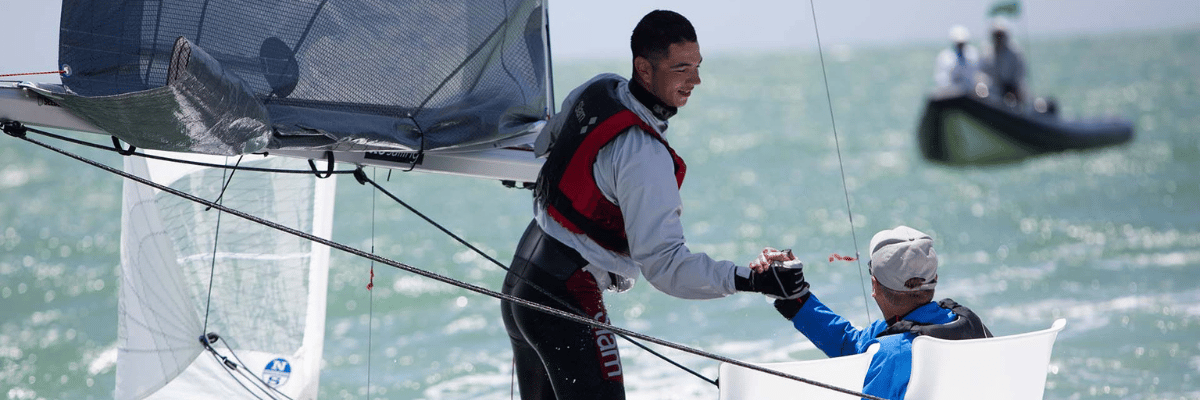
Six women challenged 34 men in the last edition of the solo-around-the-world-non-stop race Vendée Globe. They were sailing 60 foot (18.4 metre) Imoca class racing yachts, with hydrofoils to increase the speed up to 40 knots. Swiss sailor Justine Mettraux finished as the fastest female to ever circumnavigate the globe sailing solo: she set the record to 76 days. The Imoca class is still the only class in professional sailing where women and men compete equally, on equal boats and in the same fleet. Mettraux finished 8th in the overall ranking. Even in the results, there is no different ranking for women and men. The Imoca racing machines are optimised around the person of the ‘pilot’ sailing on it. This branch of the offshore sail racing sport is highly professional and while sailors and their teams must maintain the class regulations for weight and sail area, the ergonomics on board may be adapted to fit well with the sailor.
Masculine culture
In professional sailing, however, there is always the male dominance. Even men of good intentions are part of a culture that puts back women. Less muscle power can be compensated by mechanical solutions, but this gender difference appears still to be a dividing feature in the sports’ appreciation of athletes. Mettaux has experienced this. “It may be more challenging to prove yourself. But I believe that is the case for women in many fields! From a physical standpoint, offshore sailing is a bit more demanding for us, but that is the only aspect that could hinder a woman in her career as a professional sailor. Personally I refuse to consider this as an obstacle, and I try not to see this as a difference.”
Progress
The Magenta Project, World Sailing and the Olympic and Paralympic Committees are campaigning to change the culture in the sport that favours men over women and mobility challenged sailors. Still, women get smaller payment checks for finishing an immense achievement like the Vendée Globe. However, slowly but undeniably, progress towards more inclusion is being made.
Ergonomics
Do boats change now that genders and abilities on board get more diverse? Only in special cases, is the short answer. Boat layout and accessibility would be a major priority. Women, small people and challenged people often request improvements to ladder placement and height, winch design that doesn't require excessive grip strength, hatch weight reduction, and line handling systems that are more intuitive and less physically demanding. Current boats are typically designed around male physiology and strength profiles, which creates unnecessary friction for everyone else. Visibility from the helm station and reach to controls matter significantly. Many boats position wheels, throttles, and instruments based on typical male arm length and torso proportions, forcing shorter sailors to stretch awkwardly or reposition themselves constantly. Cabin ergonomics including galley layout, bunk sizing, and storage accessibility are often overlooked in traditional designs. Women note that cabins designed for one body type can be inefficient or even unsafe for others.
Design study
Academic thought has been dedicated to inclusive design over the last years. Toronto-based designer Paolo Ferrari wrote in 2020 his book Planning Inclusive Yachts - A Novel Approach To Yacht Design as a researcher from the University of Trieste. Ferrari reasons: the world population is diverse. Design for Inclusion is opening up leisure boating to a much bigger audience. Older citizens can enjoy boating longer. His book explores the design possibilities to ensure access for people with disabilities within the specific demands of a motor or sailing yacht. Ferrari focusses on monohull boats. They are much more challenging to provide safe space for disabled then multihull boats. Just by stating this, the author offers the most probable way to make boats accessible: choose a multihull. There is a larger platform between the hulls, that is easily adapted to grant access for wheelchairs for example.
Practical ideas
In his study, Ferrari has included examples of several sailboat designs to clarify how principles of accessibility can be applied in boats. Getting on a boat is one major problem in boats as they are. A wide gangway or even a lift at quays that are higher, is needed. The steering wheel needs to be open, so a person in a wheelchair can roll close enough to handle the wheel. The actual steering mechanism can then be mechanically fitted under deck. Lifts from the deck down in to the cabin are a possibility, or a sloping path from the deck into the interior. His study “Revealed that the nautical industry is lacking in availability of accessible means of transport,” writes Ferrari. “It is necessary that the boat building industry adapts these design principles.”
Paralympic sailing
Sailing boats for people with mobility challenges are in use already. Paralympic sailing has evolved of the last decade into a sport that has athletes worldwide. There are currently three classes in Paralympic sailing in which people of various disabilities compete: The 24m², the Hansa 303 and the SKUD18. The 2.4m² is a one-person keel boat, the Hansa 303 and the SKUD 18 are two-person keel boats. Some of these boats, depending on the nature of the sailor’s disability, are equipped with joystick or servo-assisted steering, specialised seating, or equipment for hoisting sailors in and out of the boat. The athletes can be all-disabled or a combination of a full-able sailor and a challenged sailor can be in a boat.
Ready available
RS Sailing has developed a new class with the RS Venture. Fleets of these boats are racing – mostly around the UK. There are several providers of specialised boats for people who are bound to wheelchairs. Some examples are: the Wheelyboat Trust from the UK builds four types of open motor boats that are designed for easy access with a wheelchair. Cohh Yachts from Turkey builds large motor yachts that are fully adapted to the needs of people in wheelchairs. Yacht design office Simonis/Voogd created the S/V14 in Cape Town, SA, that provides access for challenged sailors to manage a sporty one-person sailing dinghy. The Sonar is a former Paralymic boat, a three person keel boat. H2O mobility from Florida, US builds new accessible boats and adapts existing ones for the mobility challenged.
Independance
A lot of these designs still require full abled persons to accompany the sailors. In his study, Ferrari aims to overcome that last challenge for the aspiring sailor and yachtsman with a desire for the sea.