Complete yacht structures printed
Rapid development of robotic arm additive manufacturing
Hulls up to 12 meters with the superstructure and interior outlines included, are created within hours using additive manufacturing. Strength, custumisation, recyclabilty and the absense of coatings make these boats and yachts competitive to conventional leisure craft. 3D priting can take boat building to a new level of sustainable production. Hans Buitelaar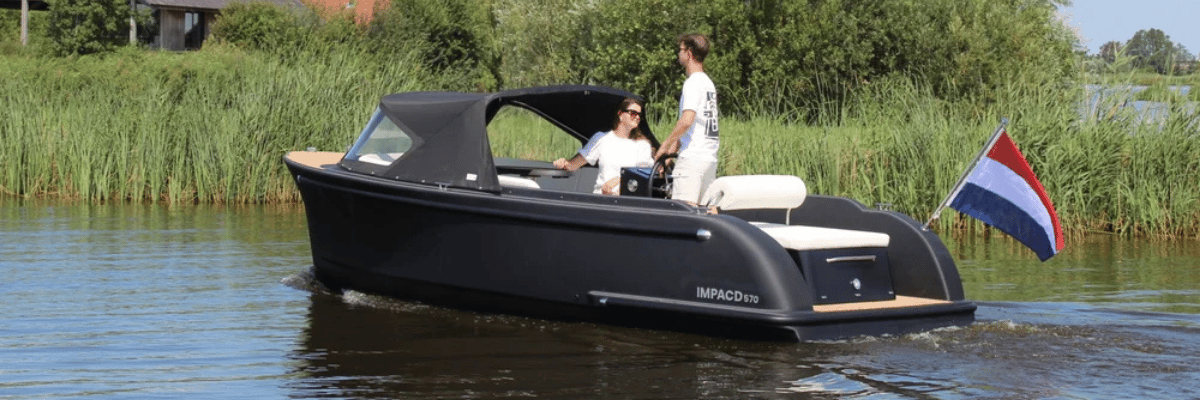
“With additive manufacturing, only the material that is needed is put into the hull and superstructure of a boat,” co-founder Charlene van Wingerden of Dutch Boat Factory begins her explanation of the many benefits of using a large robotic arm 3D printer for yacht building. “Unlike building hulls from fiber reinforced composites, where parts of the fiber mats are cut away, or building in steel or aluminium, where parts of the metal sheets are cut away, with 3D printing there is no excess material. Even when the recently introduced material HDPE is applied, still considerable sections of the plastic sheet become waste. Still, this is not the main reason for using additive manufacturing in boat building.
Automation is the biggest cost reducing factor. Design and engineering is something that needs to be done for every boat. This remains with 3D printing. But the labour intensive workshop construction is eliminated. The printer can run for hours unattended, during nighttime and weekends. Of course, some supervising is needed. A printer needs it’s feed of raw material. Along the printing process, the bonding of different added layers to the construction needs to be inspected. But even this check for bonding results is automated. Should a printer detect a flaw in the bonding during the printing, it will stop automatically.”
LFAM
The first yards that build complete boats using additive manufacturing, produce market-ready boats. The boating community embraces this building method. Long robotic arms are used, that have a reach of over 12 meters (40 foot). The robotic arms are controlled by a computer program that translates the boat design into the printer head’s movement. Thermoplastic material flows through the printer head, is heated and cures in strong bonding to the former layer of material. This way of creating structures of (nowadays) up to twelve meters long is called Large Format Additive Manufacturing (LFAM). The size of structures that can be printed is increasing with the continuous progress in technology and available materials.Hull strength
While this still needs some extensive engineering, the printing robotic arms can create any shape. Transverse and longitudinal frames can be created in the same printing run as the hull skin. Double walled hulls can be printed in one run, openings for inspection hatches included. The printing does not stop with the hull itself, also the foundations for engines, the supports for wiring and piping, the outlines of the furniture and pedestals for steering equipment can be ready before the printing stops. Key for boat building is to calculate – and prove – sufficient strength of the structure. 3D printing company CEAD from Detroit, USA, with a second base in Delft, the Netherlands, developed the Faber Navalis. This is a complete package to start printing boats: the machine, the software and the tough material to print military-grade boats – according to the company. CEAD proved the practicality of the Faber Navalis package by printing a 5.7 meter console fishing boat.Impact
Structural strength is closely related to the material used. Several types of thermoplastic printing material are available. Typically, these materials come in grains that are fed to the printer head. PET is often used as a printing thermoplastic. Large quantities of recycled material (from soda bottles) are available. This makes a boat, printed from PET material, a quite sustainably produced product. The material is all re-used. Along with other materials, some of them having glass fiber re-enforcement. At CEAD’s Marine Application Center, from which Van Wingerden’s DBF originates, the tough material HDPro was developed. This is a thermoplastic that has the same properties as HDPE (High Density Poly Ethylene). This material has very high impact absorption. A boat grounding on rocks will not result in breaking and leaks, HDPro should withstand such poundings.Recyclability
Boat Evolution from Maine, USA, build ready-for-launch tenders using LFAM. Aiming to use 100 per cent recycled materials and preparing their boats for electric propulsion, they strive to deliver boats with as low environmental impact as possible. Apart from using recycled base material, the recyclability of the ready printed boats is also quite good. After the boat’s life cycle, it can again be shredded and the material will be used to print a new boat. That is why Doug Anderson, one of the four founders at Boat Evolution, wants tokeep the tenders as clean as possible. No or very little accessories should be added to the boat. “We don’t want to paint them. We don’t want to add adhesives unnecessarily, or anything that could get in and hinder recycling,” Anderson said in an interview with Professional Boat Builder magazine. “We’re trying to keep it as pure as we can so you could literally grind it up and print another boat.”Customising
Printing boats is a process without moulds. Therefore, every individual boat can be changed. Changes to the boat, the steering position, the furniture base or the engine mount would require some engineering in the computer design. A customised boat will be printed. The printer does one run at a time. And the grains that feed the printer head can come in any colour.No coatings
“We want to engage with many partners in the development of ever more sustainable and better boats,” says Brand- and Business Development Manager Marije de Vries of Impacd Boats from Woudsend, the Netherlands. But even today, the tenders and launches that Impacd builds, are respected leisure and working craft. For leisure boating, the yard offers 6 models of open motor boats in the range from 5 to 7 meters. A 9 meter model is in development. “Our boats are robust. They do not dent or scratch. Other boat building materials will be damaged when bumping into shore of quays. The material we use, offers poor adhesion of paints.We can print in any colour, so we do not paint the boats. Poor adhesion also means that marine fouling does not attach easily, either. An important extra sustainability gain is that we do not need to use antifouling paints.” While Impacd Boats has quite successfully entered the market of leisure tenders and launches, they also build workboats and do special projects for the ministry of defence, developing unmanned surface craft. The innovation department is an important branch in the company, working with marine research institutes and universities.