The race to full offshore foiling
The open sea is the next frontier for fully out-of-the-water foiling. The 40OF aims to cross that frontier. The 40 foot long monohull racing yacht, designed for offshore foiling, should excel in the classic RORC offshore races like the Fastnet Race, the Middle Sea Race or Sydney-Hobart Race. That is what the design- & development team of the 40 Offshore Foiler envisions.
Author  Hans Buitelaar
Hans Buitelaar18 August 2026
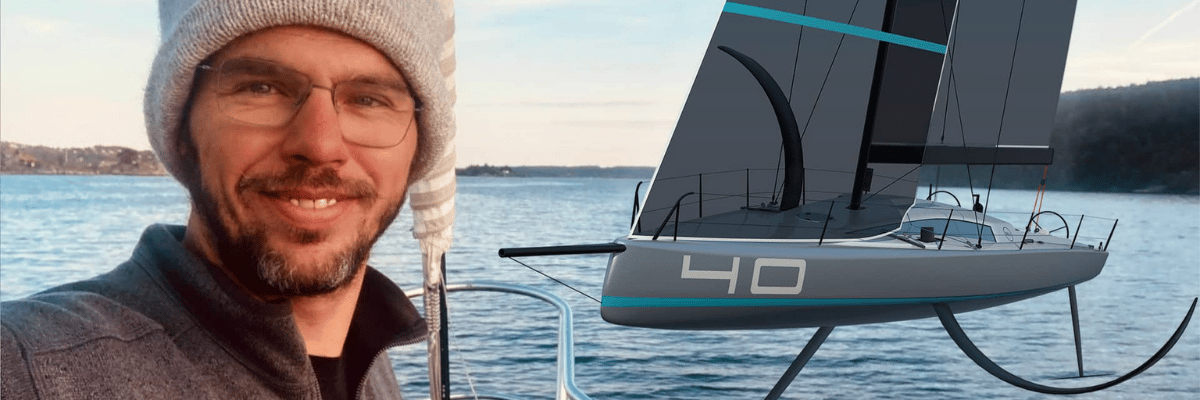
Yacht designers Wilson/Marquinez from Argentina recognised the need for an offshore foiler in 2020. Designer duo Nahuel Wilson and Laureano Marquinez were involved with the development of the America’s Cup AC75 full foiling monohull of Ben Ainsley’s Team Ineos. Before that, they worked with Juan Kouyoumdjian on development of the Volvo Ocean Race 70 foot yachts. Juan K.’s yachts turned out to be winners. But most relevant: Wilson/Marquinez have designed the 69F Persico. This full foiling one design class served as a training and qualifying foiling monohull for the youth America’s Cup. Many races were sailed on Lake Garda in Italy.
In offshore ocean racing, there are no full foiling boats yet: meaning that there is not yet a sailboat that will fly with its hull completely out of the water over the waves of oceans. Demands for ocean sailing are simply too high. There are massive waves. Seldom, an ocean is crossed without encountering at least one storm. Ocean crossings are long: the hulls, foils, rigging and sails endure a lot of stress for a long period of time. That is why the monohull yachts on ocean races that do use foils, are not designed to be lifted totally out of the water.*
The team works to find buyers who want to invest in the development of a full foiling 40 foot one design class. In mode 1, the yacht can be sailed in displacement mode. The curved C-foils swing through a slot in the hull and can be moved all the way up, so that only the tips of the foil will extend from the hull surface, like small fins. In mode 2, there will be foil assistance to increase the righting moment of the sailboat. The hull will not be lifted out of the water. In mode 3, the hull will be lifted out of the water but the stern will stay in the water.
The foiling wing on the bottom of the rudder will stay neutral or even negative (pulling the rudder and stern down) to hold the back end of the boat in the water. Finally, mode 4 is full foiling. The lifting force of the big c-foils that carry the hull weight, is maximised. The wing foil at the bottom of the rudder is maximised. The foils lift the 40OF in conjunction with the canting keel. Twin rudders are installed at the stern, so when the yacht will heel, the leeward rudder will be vertical in the water and deliver maximum steering thrust and deliver maximum lifting power from the foil at its bottom end as well. Water ballast tanks are added to deliver more trim opportunities and boatspeed in all modes. “To switch between modes, the foils, the rudder foils and the keel can be trimmed,” Landman says.
The delicate balance of boat weight and righting moment from the foils will then disappear. So in such conditions, the 40OF would sail in displacement mode or foil assisted mode. It is then still a quite competent racer. We plan to do more of these calculations, based on the real on-the-water conditions, wind and waves, that occur during the races, but with conditions that would allow the 40OF to go in full foiling mode – at least during considerable parts of the race.”
USA offered to build the 40OF in pre-preg carbon. The hull and foils will be cured in the autoclave at the yard. This ‘formula one style’ building method will result in a more expensive boat. Exploration talks with yards in Asia and Europe are pending. The developers aim to have a network of yards around the world that can build and deliver local service for the 40OF fleet.
The 40OF’s would also participate in the classics like the Fastnet Race, Middle Sea Race and Sydney to Hobart Race. We need clients and investors who recognise the potential of such a class. We are anticipating the evolution of the sail racing sport worldwide. This development is advancing rapidly. A strong promotor who would also love to sail a 40OF is what we are looking for.”
www.40of.com
Demanding conditions
The America’s Cup, the 69F races, the Sail GP with it’s full foiling catamarans: these races are all on (relatively) sheltered waters. Imoca’s, one design 60 foot long monohulls that sail around the world, do have foils but are not designed to lift the hull totally out of the water. Foil assisted, is how these boats are described in the community of foiling sailors.In offshore ocean racing, there are no full foiling boats yet: meaning that there is not yet a sailboat that will fly with its hull completely out of the water over the waves of oceans. Demands for ocean sailing are simply too high. There are massive waves. Seldom, an ocean is crossed without encountering at least one storm. Ocean crossings are long: the hulls, foils, rigging and sails endure a lot of stress for a long period of time. That is why the monohull yachts on ocean races that do use foils, are not designed to be lifted totally out of the water.*
Four modes of sailing
Enter 40OF. This yacht is designed to withstand all the loads and stresses that ocean racing puts on boats. The design was first presented during the Dusseldorf Boatshow in January 2025. With ocean sailing in mind, the yacht can sail in different modes, as Willem Jan Landman explains. Dutchman Landman is the networker in the sail racing world who gets a team together with designers, foiling experts and yards to participate in building a one design class.The team works to find buyers who want to invest in the development of a full foiling 40 foot one design class. In mode 1, the yacht can be sailed in displacement mode. The curved C-foils swing through a slot in the hull and can be moved all the way up, so that only the tips of the foil will extend from the hull surface, like small fins. In mode 2, there will be foil assistance to increase the righting moment of the sailboat. The hull will not be lifted out of the water. In mode 3, the hull will be lifted out of the water but the stern will stay in the water.
The foiling wing on the bottom of the rudder will stay neutral or even negative (pulling the rudder and stern down) to hold the back end of the boat in the water. Finally, mode 4 is full foiling. The lifting force of the big c-foils that carry the hull weight, is maximised. The wing foil at the bottom of the rudder is maximised. The foils lift the 40OF in conjunction with the canting keel. Twin rudders are installed at the stern, so when the yacht will heel, the leeward rudder will be vertical in the water and deliver maximum steering thrust and deliver maximum lifting power from the foil at its bottom end as well. Water ballast tanks are added to deliver more trim opportunities and boatspeed in all modes. “To switch between modes, the foils, the rudder foils and the keel can be trimmed,” Landman says.
Calculating potential
“We have calculated the (theoretical) sailing time of a 40OF as if it had participated in the Newport to Bermuda Race 2026,” he continues. “We have taken the real life circumstances into consideration. There were big waves and strong winds during the most recent edition. We understand that in such conditions, the crew needs to hold back on foiling performance. Flying the hull above the water on foils is one thing, flying off waves with no contact with the water at all is a totally different game. This will make the boat slam on the water.The delicate balance of boat weight and righting moment from the foils will then disappear. So in such conditions, the 40OF would sail in displacement mode or foil assisted mode. It is then still a quite competent racer. We plan to do more of these calculations, based on the real on-the-water conditions, wind and waves, that occur during the races, but with conditions that would allow the 40OF to go in full foiling mode – at least during considerable parts of the race.”
Network of yards
Landman, working from his company Sailing Architect together with his business partner Pablo Bottacchi based in Buenos Aires, Argentina, have found two yards that have produced quotes for building the 40OF and became the build & development partners. The yard Evolution Marine from Cape Town, South Africa offered to build the yacht in full carbon, using the fiber infusion method. They calculated a price of 1.9 million Euros for a fully rigged and equipped boat. Additionally, the yard Moore Brothers from Bristol, Rhode Island,USA offered to build the 40OF in pre-preg carbon. The hull and foils will be cured in the autoclave at the yard. This ‘formula one style’ building method will result in a more expensive boat. Exploration talks with yards in Asia and Europe are pending. The developers aim to have a network of yards around the world that can build and deliver local service for the 40OF fleet.
One Design Class
The design- & development team of the yacht is planning to build a one design class. “Yes, it is hard to get over the threshold of building the first real life prototype and then developing further into a full size one design class,” Landman admits. ”We envision a class with fleets around the world that engage in regional regattas.The 40OF’s would also participate in the classics like the Fastnet Race, Middle Sea Race and Sydney to Hobart Race. We need clients and investors who recognise the potential of such a class. We are anticipating the evolution of the sail racing sport worldwide. This development is advancing rapidly. A strong promotor who would also love to sail a 40OF is what we are looking for.”
Offshore Regulations
To be contenders in the classic regattas, the ORC and IRC rating offices would have to develop a formula that includes foiling yachts into the rating system. Foil assisted yachts, like the ‘Raven’ from Baltic and several custom made yachts like Wild Oats XI, now named Palm Beach XI Racing., are already competing in such offshore sail races. The 40OF is designed to meet all the requirements of the World Sailing Offshore Special Regulations. This includes an engine that can propel the yacht over a distance.. This may be a combustion engine of electric propulsion.Class logistics
To build an attractive racing program, Pindar from the UK joins the 40OF team as a logistics partner. The yachts need to be transported to the various regatta locations. To keep things simple, the team plans to have races in the main yachting regions around the world in separate competitions: the Americas, Europe, Asia and (South) Africa. “Hopefully, in ten years, there will be regional fleets of each at least ten boats in these four regions,” Landman says. “We see one design offshore foiling as the next stage in sail high performance offshore racing.”www.40of.com