Going green the clever way
Get the most out of sustainable composite options
Reducing the environmental impact of boat construction requires a holistic approach. There are multiple sustainable materials and production methods to choose from or even combine. Yet, to achieve the biggest gain in sustainable operations, a manufacturer needs to know where the best positive impact can be made.
10 April 2026
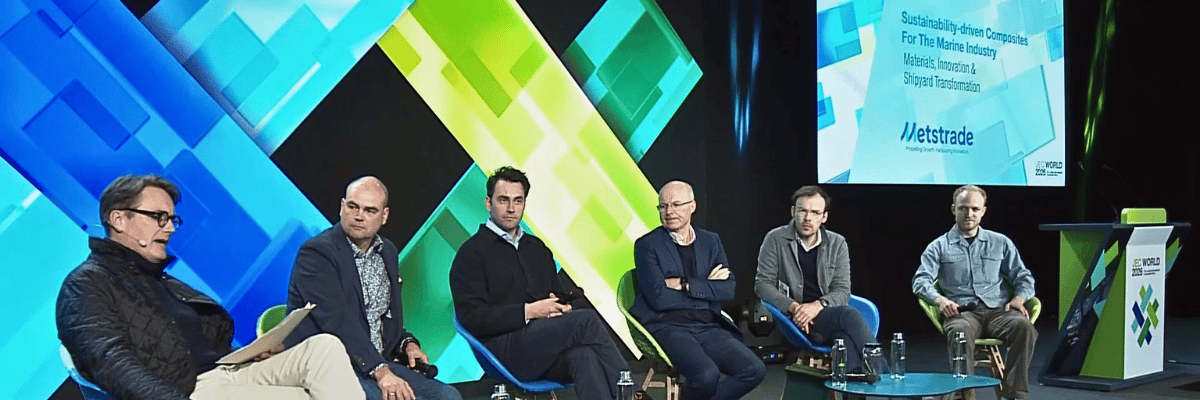
The marine industry experiences an exceeding pressure to decarbonise. Luckily, there is also a growing number of suppliers who deliver solutions to answer to this demand. Focussing on construction methods in composite boat building, five experts in sustainable construction and recycling composite base materials, joined in a forum discussion during the JEC World congress and exhibition to exchange ideas about the best way to reduce the carbon footprint of leisure boating.
Boating as a special sector
JEC – which is an acronym of Journées Européennes de Composites – has become the global platform connecting all industries that produce or apply composites: resin manufacturers, fibre manufacturers and their clients in the automotive, aeronautical, marine, maritime, wind energy and other industries. While the leisure marine industry is not the biggest user of composites, volume wise, this sector takes a specific role. Racing yachts are built to take high loads at minimal weight. The structural parts of series produced leisure boats are made completely out of composite. This can be the most commonly applied glass fibre and polyester construction or carbon fibre and epoxy. Natural fibres from flax, hemp or basalt rock have made their entry into the yacht building sector, as well as recyclable resins and resins from natural sources like line seed oil.Carrot or stick
“Because the marine industry is a low-margin industry, where the profit percentage is quite little as compared to the production cost, yards are not likely to take high risks in their production methods,”Ollie Taylor describes the situation. Taylor is director at Marine Futures, a consultancy company from the UK that helps boat builders to perform Life Cycle Assessments (LCAs) on their production methods and has launched the MarineShift360 LCA tool.
“So there is some reluctance to change proven production methods. We see that legislation is often a driver to change production. We would describe this as an incentive with a stick rather than an incentive with a carrot.”
Less weight, less fuel
Arnold Vaandrager, director at VABO Composites from the Netherlands, sees a viable business case even without regulations:“In work boats, often made from steel, replacing parts of the construction with composite results in substantial weight reduction. This leads to less propulsion power needed and thus in lower fuel consumption. Using less fuel in commercial operations is a competitive advantage that also results in emissions reduction.”Yet, Vaandrager realises, leisure craft are used very little as compared to commercial craft, meaning that fuel consumption takes a way smaller part in the overall ecological footprint. Maybe on large motor yachts, reducing fuel consumption for propulsion can deliver a positive impact on pollution reduction. But in the user case of large yachts, the air conditioning is often the biggest consumer of onboard energy.
Know the impact
“To begin with meaningful reduction of a yacht’s ecological footprint, you need to establish which part in the cycle of materials sourcing, production, use and after the boat’s lifetime, recycling, the biggest pollution is caused.”Taylor says.
“If you can choose from a number of options to use other materials, change your production method, change the vessel design or prepare for recycling during the design process, it is crucial to know where in your current operations, the most pollution is caused. It is at that stage in your operations that you can make the biggest positive change.”Overseeing numerous cases, Marine Futures has learnt that with leisure boats the footprint is biggest in the production phase.
Increased experience
Gresh Chapman is co-founder and CEO Circular Structures from the US that offers natural fibres to composite constructors like yards.“We often see a misconception in the use of flax fibres,” he notes. “People tend to conceive natural fibres as a one-on-one replacement of glass fibres. Doing so, a lot of the additional benefits of natural fibres are not fully experienced. There are other characteristics of hemp or flax fibres. In every case, they add a certain warmth and an increased user experience to composites.
” Natural fibres can potentially become a big and cost efficient material for composites. There is a lot of flax and even hemp being produced in agriculture in both Europe as in North America. “But it is only produced for the seeds. The fibres are often burned,”Chapman knows. It can be quite good for farmers and for our industry to harvest the enormous potential of fibres that are grown anyway.
Length is strength
“We harvest carbon fibres from disposed carbon epoxy structures,” Stanislas Leroy explains. He is sales manager at Nova Carbon from France, that provides ready-for-use carbon fibre tapes and weaves for production. “Most composite recycling plants put all structures in the shredder and cut the lengths of the fibres. While the length is an important quality that adds to the strength of the resulting composite structure.”
Automated fibre laying
Luc Talbourdet uses such long recycled fibres at Avel Robotics, also from France.“We apply recycled carbon fibres in the foils we produce for Imoca class racing yachts. We make sure that a single strain of fibre runs from the base of the hydrofoil all the way to the tip. When working with sail racing teams, we need to offer a structure that is at least just as good as virgin material. These teams are in sailing to win. Composites that perform best, will help them win. Thanks to new rules in the Imoca class, there is an incentive to use recycled materials. Teams are limited in their ecological footprint and can operate within this limit by using recycled carbon.”Avel Robotics has developed an automated fibre laying machine. Even if working with virgin fibres, this machine can reduce the amount of fibres used. A lot of the carbon fibres are cut off after the composite has cured. The machines from Avel robotics can lay out the fibres fo maximum performance and in the same time reduce the waste.
Being positive
Taylor is pleased to learn about all the sustainable possibilities. He urges not to focus on one aspect of eco friendly operations, but oversee the whole picture.“We advocate a holistic approach. We tell our clients not to focus on only the aspect of reducing carbon emissions. Production can have other impacts. The use of water, the use of rare minerals, the wellbeing of staff or the impact on a local community. All of these aspects need to be taken in account. If you produce while causing zero carbon emissions, but take away a lot of water from the community in a water scarce area, your impact will be evaluated as not so positive. Try to oversee the whole process and choose your operations wisely.”