Upcycling disposed composites
Re-use of GRP ready for large scale application
Harvesting the fibres and resin from end-of-life yachts and using them to build new ones, is on the threshold of industry-wide adaptation. Studies, experiments and also first real-life applications are undertaken in projects at universities and companies all over the world. Limited availability of virgin materials, together with considerations about sustainable and circular production, drive innovation towards recyclable resins and fibres as well as methods to recover them from waste products.
 Hans Buitelaar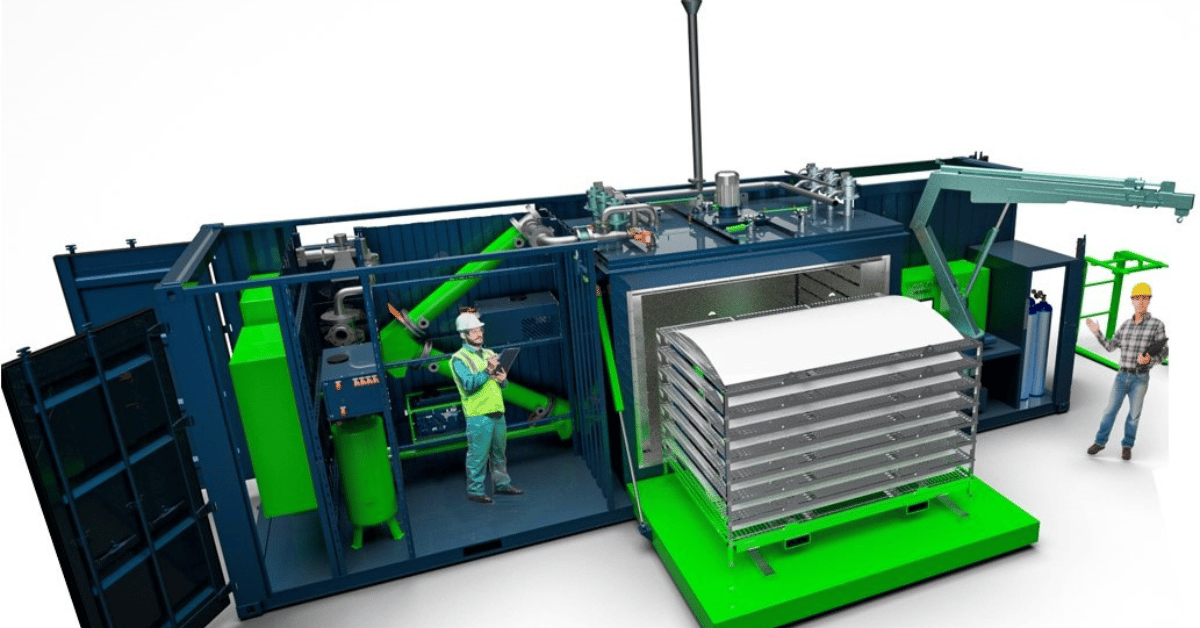
Efforts by pioneers like Greenboats from Germany, who started building sailing yachts from flax fibre and line seed oil based epoxies, as well as Innovation Yachts from France, who were first adapters on the use of basalt fibre, have led to the adaptation of more sustainable materials by market leading fibre and resin manufacturers. Yet, if yards only start building with materials that can be recycled by now, the first re-use of composites from these boats will only be in 30 years. That will not solve the problem of end-of-life GRP boats that have been piling up as landfill over the last 20 years.
Solve Resin
First recycling projects with used composite materials are not with scrap boats. Dismantled wind turbine blades were the base material for the real life test for Resolve Composites’ method of Solvalysis, which they call ReceTT. “We got a wind rotor blade to use the materials for building a 17 foot sailing boat,” CTO Nick Bigeau tells at the North American Stage at last November’s Metstrade. “We developed and tested our ReceTT method of separating cured resin from fibres, and now wanted to prove that we could apply it in real life.” ReceTT is a method we developed and a tool, too. We attach a seal to the surface of a composite that we are going to dismantle. Under the seal, we apply solvents to the surface. This solves the resin, even if this has been cured decades ago. After the process, we get ‘clean’ fibres, with about 30 % of the resin left in it.” After the separation, the fibres can be used again to build something new. Final collection of the pre-used fibres is still demanding work by hand - a gloved hand that is. Various layers of fibre mat that have been bonded together, need to be peeled apart. The resin is gone, but understandably, the fibre mats maintain the form and position they have been in for years. When carefully taken apart, the mats of fibres can be rolled up. The dry material is ready for use in a next composite construction.
Melt Resin
Bigeau’s fellow developer from Switzerland, Guillaume Perben from the company Composite Recycling, uses Thermolysis to separate cured resin from fibres. He shares the story of his company’s recycling development at the same panel presentation during Metstrade. “We heat the used composite in a closed environment where there is no oxigen. With oxigen, the heated oil-based resin would burn in flames. We aim to melt it. During the process, the resin vaporises. We clean the fibres for re-use. We do this with both glass fibre as carbon fibre. We capture the gasses of the vaporised resin and condense them. This results in oil, to be used to manufacture new resins or for other applications.” The company has developed a mobile thermolysis plant, that fits into a sea container. Companies that have a load of end-of-use composite, can bring the thermolysis container to their workplace and process the composite in the mobile processing unit. They will be able to harvest fibres and oil.
Heat & chemicals
Norwegian company Gjenkraft has developed a method they call ‘Pyrolysis’ to separate the materials in windblades. This is a thermo-chemical process to convert discarded wind turbine blades into a diverse range of raw materials. From glass and carbon fibers to syngas, synthetic oils, gas, and carbon powder. The company joins in the European Union project of REFRESH, which funds company research into sustainable ways of recycling.
Combine methods
The entrepreneurs have demonstrated composite recycling at small scale, but with viable options for up-scaling. At the Metstrade presentation, they envision a combined application of the technologies they developed. While Resolve Composites uses solvalysis and Composite Recycling applies thermolysis, the CEO’s speak out that for large-scale industrial recycling, these two techniques should be brought together. “Thermolysis and Solvalysis need to be brought together,” Bigeau says. “There are so many different kinds of composites. Glass fibre, carbon fibre, polyester resin or vinylester or epoxy, sandwich laminates of solid. There is no one-size-fits-all solution.”
Scale up
“How will yards be able to dismantle the GRP boats they have built over the last decades?” Fabio Bignolini rhetorically asks. The CEO of Italian boatbuilder NL Comp is a frontrunner on building high-end yachts using recycled materials. The company researches recycling methods of composites and then uses the reclaimed materials. “We have concluded that mechanical and chemical recycling of thermoplastic composites is possible. We are now pushing on finding recycled carbon fibre. We build high-end boats and carbon of course allows for lighter boat building at the same strength. What we have found is that the bio-based composites do not allow for separating the fibres and the resin as for now. Balsa core composites, built around the natural material of balsa wood as a core, can not yet be processed in a solvalysis or thermolysis treatment. The cost of gathering all of the end-of-life GRP boats, getting off all of the appliances and other materials, cutting the clean composite into processable pieces and then recycling this, is huge. The value of the reclaimed material has to be sufficient.” Bigeau poses the question: “How do we scale up to industrial volumes? The cost of reclamation can go down if large volumes of fibres and resins are recycled. Downstreams of used composites are not organised yet.
Circular chain
Groupe Bénéteau is awarded for their efforts to set up a recycling chain for composites. From source material – chemical factory Arkema manufacturing recyclable thermoplastic ‘Elium’, to collecting of end-of-life-boats by Veolia, to separation of the materials by Composite Recycling, from there to preparation for the next application by Owens Corning or Chromarat and finally the re-use of the recycled materials in yachts by Bénéteau. This chain of recylcing shows promise for the possibility of setting up large scale circular processes with composites. A prestigious conglomerate of industry associations, university expert groups, European innovation funds praised the efforts to create this recycling circle with the ‘Innovation Team Best Practises’ award.
Material value
Jut this month, Luxemburg & Bristol based start-up Uplift360 launched a campaign to set up large scale composite recovery chains throughout Europe. The company got funded 7.4 million Euros to save end-of-use GRP from ending as landfill. Apart from the sustainability aspect, in this funding round, the under estimated value of the resins and fibres is explicitly addressed as a motivator for the project. When global supply chains of virgin material stop, availability of recycled base materials is invaluable.
Existing production
In everyday practise, examples of recycling in the production process are easy to find. Polish manufacturer of large sailing and motoring catamarans Sunreef uses recycled softdrink bottles to make the core material in their sandwich composites. Elvström Sails, UK and North Sails all have yacht sails with parts or complete cloths from recycled plastics. Italian manufacturer Maricell offers Serie K composite panels for yacht interior construction, panels comparable to Trespa. Serie K is specifically constructed from waste plastic gathered at yards, closing the circularity loop even closer.