Can wind power the future of superyachts?
With 85% of the current superyacht market focused on motor yachts, what will it take to bring the endless energy available from the wind into broader application. Here we bring you a summary of some of the points made from The Superyacht Forum 2025’s Driven by Wind: Authentic innovation for a sustainable superyacht future panel.
 Kim Hollamby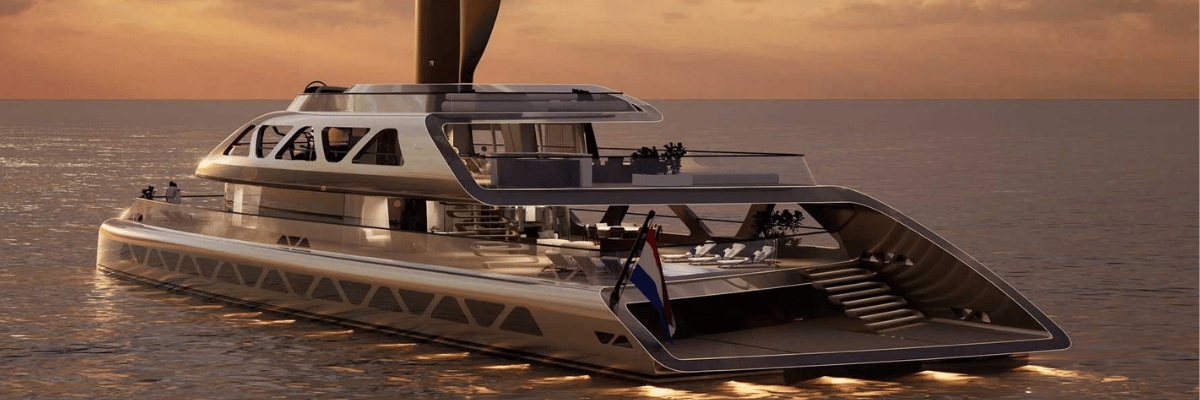
Given the superyacht industry’s now intensive focus on reducing its environmental impact, it is no wonder that the wind, and how to harness it in new and more accessible ways, is beginning to occupy more attention among some of the sector’s innovators.
One of the biggest obstacles to overcome is likely to be the wants and wishes of the industry’s own clientele. The drive towards greater stabilisation technologies for motor yachts is a strong clue about the lack of desire for guests to experience any form of discomfort out on the water. Neither would many owners want the typically significant additional costs of a sailing rig and its associated demand for greater crew training and potential restrictions on where to dock and explore.
One immediate theme of the panel was how to do a much better job of communicating the benefits of utilising wind as an energy source. Another was how to innovate with new designs and technologies to make sailing more accessible and less impactful for those seeking to enjoy the onboard experience.
Wind as one part of the energy mix
An early talking point in the session was Royal Huisman’s AERA concept yacht – unveiled at the Monaco Yacht Show last year. Conceived as the ultimate hybrid, neither sail nor power yacht, it combines a Rondal wing sail with a fuel cell powered retractable propulsion system on a futuristically styled multihull form. Is this a sailing yacht that can be operated at the push of a button without a deck cluttered with rigging? Or a wind-assisted motoryacht? In one sense it doesn’t matter because the idea is it does all of that so seamlessly, you don’t worry about how it is categorised.
Royal Huisman’s concept is a generation on again from the pioneering impact of exotic high technology large sailing yacht launches of recent years such as Oceanco’s DynaRig-equipped 107m Black Pearl, the similarly rigged Perini Navi 88m Maltese Falcon and the rotating masted 144m Nobiskrug sailing yacht A. However, AERA has a different purpose beyond simplifying sailing operations because its primary objective is fuel reduction, rather than outright independence from other fuel sources. That places it in common with the growing market for wind-assistance rigs in commercial shipping, a featured exemplar being the VPLP designed and launched 120m RoRo ship Canopée, which transports Ariana rocket components from Europe to Guyana. Its four Oceanwings sails are said to save around 30% of the fuel that would otherwise be burned if operating solely under diesel power.
It was universally agreed by the panel that harnessing wind as one part of a portfolio of energy sources aboard appears to offer the greatest opportunity for wider application.
For example, if you can purely sail under a rig, you can then hydro-generate power to restore hotel load batteries for the next anchorage. If the rig is designed primarily to assist propulsion, then you can save fuel and with it, tankage and weight, making that capacity available for alternative gear such as fuel cells and batteries. Or you can extend the range of electrically propelled vessels. Arguably wind could be employed to bridge the gap between fossil fuels and the emergence of viable new alternative fuel technologies, making up for any deficiencies in range.
Harnessing wind for propulsive effort in simpler, more accessible ways, is being addressed by a growing number of new sailing technologies including DynaRig, AeroRig, Flettner rotors and kites to name just a few. These all tackle the primary criticisms of the complexity and operational difficulty of traditional sailing superyachts with their often highly loaded rigs. But focusing on propulsive effort alone only answers a small percentage of the problem. What can wind do to assist the need for energy when the superyacht is at rest for the greatest percentage of its life?
Wind assisted hotel loads
Kites were highlighted as being one technology that could have much wider application onboard virtually any motor yacht – not just for propulsion assistance. The technology has evolved to the extent that large kites of the kind superyachts might be able to install can create between 400-1000kW when flown at heights of up to 1000m. That’s in the range of a normal hotel load. The key installation requirements being enough space, weight capacity and strength in the bow section to both handle and stow the kite. It’s not without its difficulties – most obviously if used at anchor or in a harbour the airspace would have to be closed and consideration given to other vessels and infrastructure.
The panel also discussed other means of onboard wind generation, recognising that wind generators on smaller leisure yachts were commonplace, but there was little in the way of equivalents for superyachts. One talking point was the potential noise generation of larger wind generators, particularly in superyacht harbours where multiple installations might be in operation over a relatively small area. Another was the amount of installation space required and how wind generators might be stowed when not required, either for practical or aesthetic reasons. The inconclusive nature of the conversation suggested it was an area worthy of the attention of innovators.
Customers – the ultimate factor
Ultimately the industry can innovate all manner of solutions to harness the wind, but if the customer doesn’t accept the idea of being on a vessel with a sailing rig, a kite or large wind generators, it is going to be hard to drive change through.
Some more traditionally minded owners will continue to be tolerant of the restrictions that conventional sailing yachts impose and of the cost of their rigs and crew operation. That is not to say though that these yachts cannot be reap the benefit of the latest technology to be more sustainable, as Vitters forthcoming 68.9m fossil free Project Zero demonstrates. For a yacht of this kind to work effectively, the owner may needs to accept that the nature of their design will dictate the cruising itinerary to a certain extent if they are to work correctly.
Not only for the obvious reason of wind direction and strength, but also because hydro-generation only works effectively when underway and hence a week or more at anchor may not be the best idea. Another suggestion made was that in much the same way as we have chase boats now, there should be service tugs that can move in to provide efficiently generated power and propulsive force for motherships when required.
But what about the majority of owners who don’t want additional cost, complexity and a boat that heels when underway?
There was acknowledgement that that younger members of superyacht-owning families are likely put more pressure on older generations in supporting the sustainable proposition of sailing and wind generated energy. If you combine that desire with technologies like DynaRig, where you can be moving near silently out to sea within minutes and the sails automatically feather once a modest level of heel is reached, then it is possible key points of resistance might be overcome and a sailing oriented build seem more attractive.
A motor yacht owner considering wind assistance will also certainly be concerned about potential discomfort, extra complexity, additional crew skills and of course also the impact on build costs and deck space of having a rig. That’s why it is important to develop sailing systems that are easy to use, require less crew, and take you anywhere in the world without being depending on any infrastructure.
Wing sails installed on top of elegant motor yacht superstructures as a retrofit may also seem just plain ugly. Another suggestion for keeping motor yacht owners happy but still reap benefits from the wind was to have stowable rigs that can be deployed by the crew when on repositioning deliveries between destinations but hidden when cruising with guests in local waters.
Education and innovation essential
Education was also seen as important. The industry has got to tell a much better story about why we should embrace rig systems that are affordable and easier to operate. There is a feeling that some of the rigs on large sailing yachts have gone a little bit too far, with a rat race towards higher performing rigs that aren’t necessarily required for people who just want to cruise the world.With a solid wing sail there much less complexity, because you're not trying to control the sail shapes.
The industry needs ways to break that spiral of complexity and start thinking in a different way about integrating, controlling, and creating efficient sail shapes. The future of wind-powered and wind-assisted superyachts does seem highly dependent on just how fast the industry can innovate and educate in equal measure. The wind is such an historic part of maritime history and an ever-constant factor in any sailor’s thinking, it’s hard to believe it will not play new and exciting roles in the energy mix for superyachts of the future.
The panel
The Superyacht Forum’s 2025 Driven by Wind: Authentic innovation for a sustainable superyacht future panel comprised:
Hermen de Jong, Innovation Manager at Royal Huisman
Wick Hillege, naval architect at Dykstra Naval Architects
Wim Verhoeff, Sales Director at Oceanco
Martin Redmayne, Chairman and Editor in Chief of the Superyacht Group (moderator)
The audience was also interactively involved in the discussion.
Image credit
Header image AERA, copyright Royal Huisman
The Superyacht Forum 2026
The Superyacht Forum will be held this year at RAI Amsterdam from 16-17 November 2026. Please see thesuperyachtforum.com for more details.