Military to civilian – the maritime industry career switch
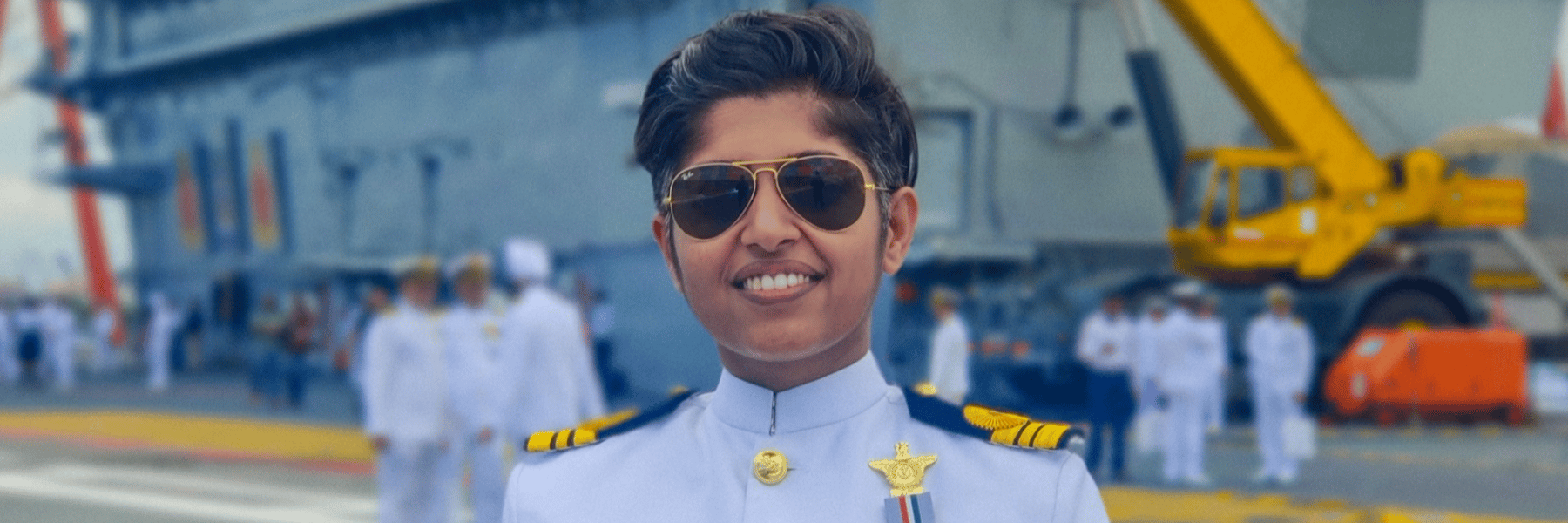
Former Indian Navy officer Darsitha Babu answers our questions about her career journey from uniformed service as a trained engineer, to preparing for a civilian maritime career in the Netherlands, inspired by people she met at Metstrade 2025
 Kim Hollamby
How did you decide on a military maritime career?
I became involved in the armed forces through the National Cadet Corps, the uniformed youth wing of the Indian Armed Forces. I was in the army section, and we undertook rifle drill, map reading, navigation and so on. I visited the Indian Naval Academy at the age of 13 and was attracted to the uniform, the discipline and the way they talked and behaved. That planted the seed to join the defence services.
After completing my bachelor's degree in mechanical engineering at the Indian Institute of Technology in Delhi I had an option of entering a service selection board, a rigorous process that selects officers for the Navy. I got selected and although I also had an option to join a corporate company, decided to commit to a short service commission in the engineering cadre for a minimum engagement of 10 years. I later took my master's diploma in naval architecture within the Navy.
Which memorable highlights do you have from serving in the Indian Navy?
I had the privilege to be posted onto several different naval platforms and work with many different organisations. An obvious highlight was being on the INS Vikrant project, my country’s first indigenously built aircraft carrier, launched in 2022. Only a few countries have the capability to build a carrier by themselves, and it was a great experience for me. Another career achievement was participating in strategic submarine projects, working on production quality assurance.
Throughout my naval service I enjoyed coordinating with equipment manufacturers and suppliers from across the globe and managing engineering teams and domain specialists. It taught me how to grow as a leader and how to manage military and civilian people with different educational backgrounds, cultures and languages.
What triggered your decision to leave military life?
As my 10 years’ service completed, I thought what next? Should I continue, or do something different? Many serving personnel will agree that it’s always tricky to redefine your purpose after a military career.
I determined that I wanted to be more directly involved in the innovation of the kinds of equipment and systems that I had seen manufacturers and suppliers provide for the naval projects I had worked on. To achieve that my family and I decided I should leave the service and explore something overseas, in a sector where my experience could be used to add value.
I also wanted to understand how businesses work and decided to study as a means of bridging into the corporate sector. We chose to move to the Netherlands last year because of its advantage as a hub for shipbuilding and the marine sector. I entered the TIAS School for Business and Society in Tilburg to take an International MBA with a focus on agentic AI. I have just completed the course and graduate in December.
How did you discover Metsrade 2025 and what was your experience like?
I attended the Impact Investment Summit in Rotterdam last year and met a company founder who suggested I should visit Metstrade. I had attended trade shows back home, but nothing of this scale, it was a big experience. It was good to see many of the familiar names of companies I had worked with in the Indian Navy, all in one place.
The first Metstrade event I attended was The Women in the Marine Industry International Panel & Networking Breakfast. The panellists were inspiring, but it was also good to meet like-minded people in the audience – amazing women founders who are starting things of their own. I then visited the Young Professionals Club to meet Henk de Vries, the former CEO of Koninklijke De Vries Scheepsbouw and director of Feadship. I was able to have a chat with him about propulsion, and he spoke about Feadship superyacht that uses hydrogen fuel, a topic of interest to me.
I also saw a lot of enthusiastic young professionals and met a naval architect who is founding his own yacht company and getting investment, just after taking his bachelor’s degree. I also learned about The Magenta Project, met a female mechanical engineer from the UK, then took the Young Professionals Club tour and chatted with the guide for around an hour after we returned to the lounge. For me it’s not just about the scale of Metstrade, but also the people who are available to talk, spend time with you, give insights and share their journey. That’s the brilliant part of the Young Professionals Club.
Later in the show I attended some of the content sessions and participated in ICOMIA’s round table discussion on using data to create smarter marinas. This topic is very close to me because I had written a paper while in the Navy proposing predictive maintenance using an AI deep machine learning process. I really enjoyed how they organised this session – there was a moderator with two speakers, but all the attendees got a chance to speak and share their ideas and knowledge from different parts of the world. I also met Hanna Dąbrowska, Technical Director of the Water Revolution Foundation.
Tell us what is happening now for you?
Meeting all these people inspired me to take to take a leap and found own company. My fledgling tech and engineering consultancy, 51 HQ, is still in its early days and I have been doing some consultancy for one client so far. I also want to make it a place where it helps ex-military people like me. There is a lot of untapped potential among former forces personnel so mentoring them and opening opportunities is a good idea. But it is not intended to be a main source of income now.
I believe I still have a lot to learn in terms of technology, management and leadership. To do that I want to work full time for a company for a long time, so I am currently searching for an employed role. Having no experience in the yachting industry has been a hindrance. But I have a lot of translatable skills and look forward to finding the right opportunity – ideally as a programme or technical project manager on new builds – but I am open to ideas.
I am registered at Metstrade again this year and looking forward to experiencing the full programme, accessing the Young Professionals Club and making new contacts.
How can companies working in the marine leisure sector tap more effectively into the expertise of highly skilled military people?
Because armed forces are highly structured organisations it is often assumed that people leaving that environment might struggle in private enterprise. But military people are trained in how to take care of ambiguous, uncertain and very complex things. From my observation military trained people become more productive as the challenges rise.
The adaption from military to civilian life should involve a mindset change on both sides. Organisations need to remember that many people leaving the military are used to getting adrenaline spikes from the satisfaction of achieving a task or mission. They are driven to make progress.
Military people need to make informed decisions about the environment they move to, ensuring it is right for them. The choices in civilian life are wide, from the potential chaos of start-up in its early stages to the highly structured systems and hierarchy of a large multi-national. Whatever they choose, the person applying should know the culture of the organisation beforehand and have clear expectations.